Five steps from a single press to five times the space.
In one device we combine Pascal's Law, hydraulic mechanical advantage, and a lever acting as a simple machine. Here is the entire sequence.
You apply the input force
A lever at the input stage makes it easy to generate the initial pressure. This lever is a simple machine in its own right, multiplying the effort of a single hand into meaningful force on the smaller input syringe.
Fluid transmits the pressure
The smaller input syringe pushes against a sealed, liquid-filled circuit. Because the fluid is incompressible, the pressure travels through the tubing intact, regardless of how the path is shaped or routed.
Mechanical advantage amplifies it
The larger output syringe has a greater surface area, so the same fluid pressure produces a larger total force. This is hydraulic leverage, the identical principle behind car brakes, hydraulic lifts, and construction equipment.
The ram drives downward
The output force pushes a ram down into the bin. Acting as a press, it flattens boxes, condenses loose material, and expels the trapped air that ordinarily inflates a bag long before it is genuinely full.
Capacity is reclaimed
One smooth, silent cycle later, the bin holds up to five times more. Fewer bags, fewer collection trips, and a markedly smaller environmental footprint follow naturally.
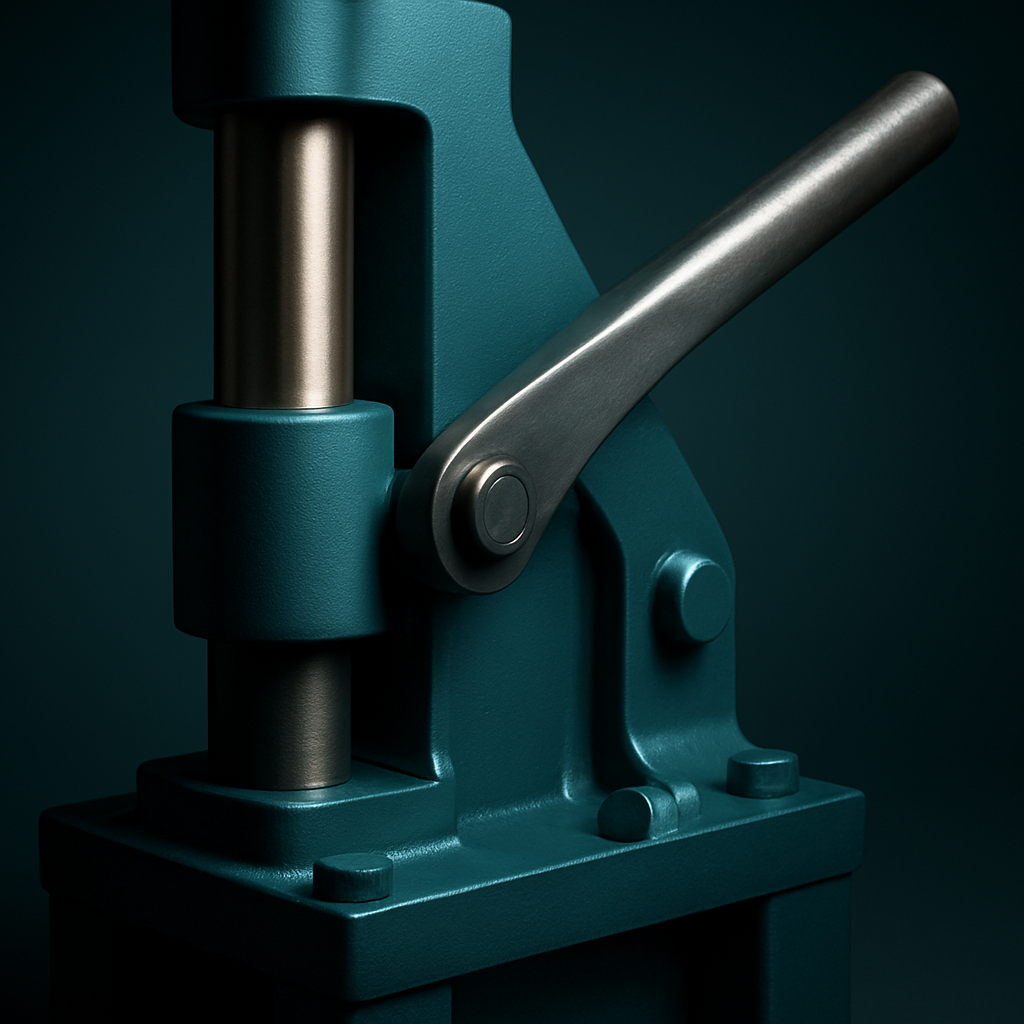
No grinding. No motor. No noise.
Because nothing mechanical grinds against anything else, the entire cycle is effortlessly quiet. We call it Fluid-Glide Motion.
Curious about the physics?
Pascal's Law is deceptively simple, and profoundly powerful. See exactly why it works.