It started with a bag that overflowed too soon.
Every meaningful product begins with an irritation no one else bothered to fix. Ours was the perpetual overflow of an ordinary bin, and the conviction that fluid mechanics could solve it.
Five turns of the iteration loop.
Progress was not linear. It was a sequence of honest dead ends, each one narrowing the path toward a sealed, silent solution.
A problem everyone recognised
Trash cans fill far faster than they should. A single cereal box or a few takeout containers overflow a bag that is barely heavy. We saw a waste of space, a waste of bags, and a waste of money for anyone paying for collection.
The first, flawed idea
We began with fans, imagining a can-crusher driven by airflow, a sort of downforce machine. It did not pan out. Air is compressible and unreliable, and the concept collapsed under its own assumptions.
The moment it clicked
Studying pneumatics and fluid mechanics, something clarified. Liquids do not compress. Push fluid through a sealed system and the pressure transfers completely, without loss. The path forward was suddenly obvious.
Syringes, tubing, and proof
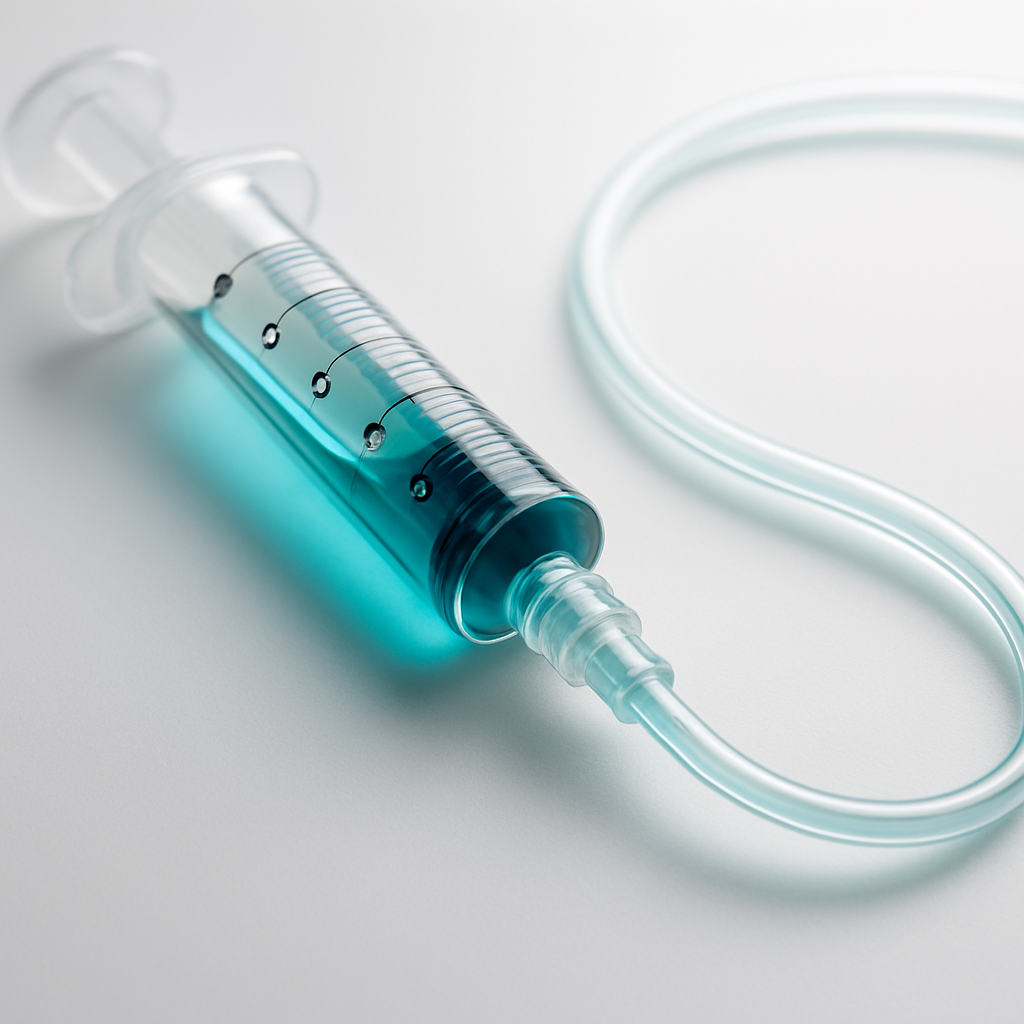
We tested the principle with syringes and sealed tubing, and it worked. A modest input force became a far greater output force pressing downward. From that humble prototype, AquaPress was born.
A name that fit
The name fused water and pressure, Aqua and Press. It sounded clean, technical, and it described precisely what the device does. The identity wrote itself.
“Push on one end of a sealed liquid, and that push emerges from the other end with the same pressure. We just pointed it at the one thing everyone needs: a bin that does not overflow every two days.”
The AquaPress Founders
The science is the story.
Understand the principle that turned a classroom experiment into a commercial device.